
Start a Raleigh People Search
A strong search begins with the fact already known. A full name points toward deeds, court parties, voter registration, business filings, and license records. An old street address works better in Wake County real estate records and iMAPS. A death date can lead to an obituary, estate file, city directory, or historic vital register. Keep middle initials, former surnames, nearby dates, and past addresses because Raleigh’s rapid growth produces many same-name results.
Raleigh records sit at three government levels. The City keeps municipal permits, council material, code cases, police reports, and staff contacts. Wake County keeps recorded land papers, tax parcels, local certificates, and most trial-court files. North Carolina agencies run the statewide voter, business, license, corrections, and vital-record systems. The right sequence limits false matches.
- Search the exact name and common spelling variants. Save any address, parcel key, case number, or record date.
- Use Wake property tools when an address is known. They can supply an owner name, REID, PIN, and deed reference.
- Carry the name into the deed index and eCourts. Compare roles, dates, and identifiers before deciding two entries describe one person.
- Use obituaries, directories, estates, and historical registers when tracing relatives or an older Raleigh resident.
- When the web trail ends, switch to a counter terminal, written request, library collection, or State Archives series.
Note: A mailing address, owner address, and physical parcel address may identify three different places, so copy each field with its label.
Raleigh Records Offices and Search Routes
Several custodians can hold facts about the same Raleigh person. The Wake Register of Deeds connects grantors and grantees to recorded instruments. Wake Tax Administration ties current owner names and mailing addresses to parcels. The Wake Clerk of Superior Court keeps civil, criminal, estate, and special-proceeding files. Raleigh’s city records staff route municipal material that is not already available through a self-service system.
Wake Register of Deeds
300 S. Salisbury St., Suite 1700
Raleigh, NC 27601
919-856-5476
Wake Clerk of Superior Court
316 Fayetteville Street Mall
Raleigh, NC 27601
919-792-4000
County court files and copies
Raleigh City Records
222 W. Hargett St.
Raleigh, NC 27601
919-996-3000
Municipal records and routing
These channels are not interchangeable. A deed index entry points to the recorded paper, while a court summary points to a clerk file. City permit staff cannot certify a Wake deed. The detailed rules for inspection, copies, and requests belong with Raleigh public records access, but the practical rule is simple: ask the office that created or keeps the record.
Search Raleigh Deeds by Party
The Wake Consolidated Real Property Index, also called Books! Online Records Search, is the main name-to-land trail. It is not an address directory. Search a grantor, the party giving an interest, or a grantee, the party receiving it. Wake’s own help compares the index to a library card catalog. The underlying deed, deed of trust, lien, or plat controls, so open the document image when one is available.
| Search field | Use | Format note |
|---|---|---|
| Grantor or grantee | Find a named person or firm | Enter surname and first name; use at least three characters |
| Party type | Separate people from firms | Choose both, human, or non-human |
| Recorded dates | Narrow a long name list | Use month/day/year |
| Book and page | Open a known instrument | Maps use BM plus year; condominium maps use CM plus year |
The Wake CRPI search screen shows the actual party, date, and book/page controls used for Raleigh deed research.
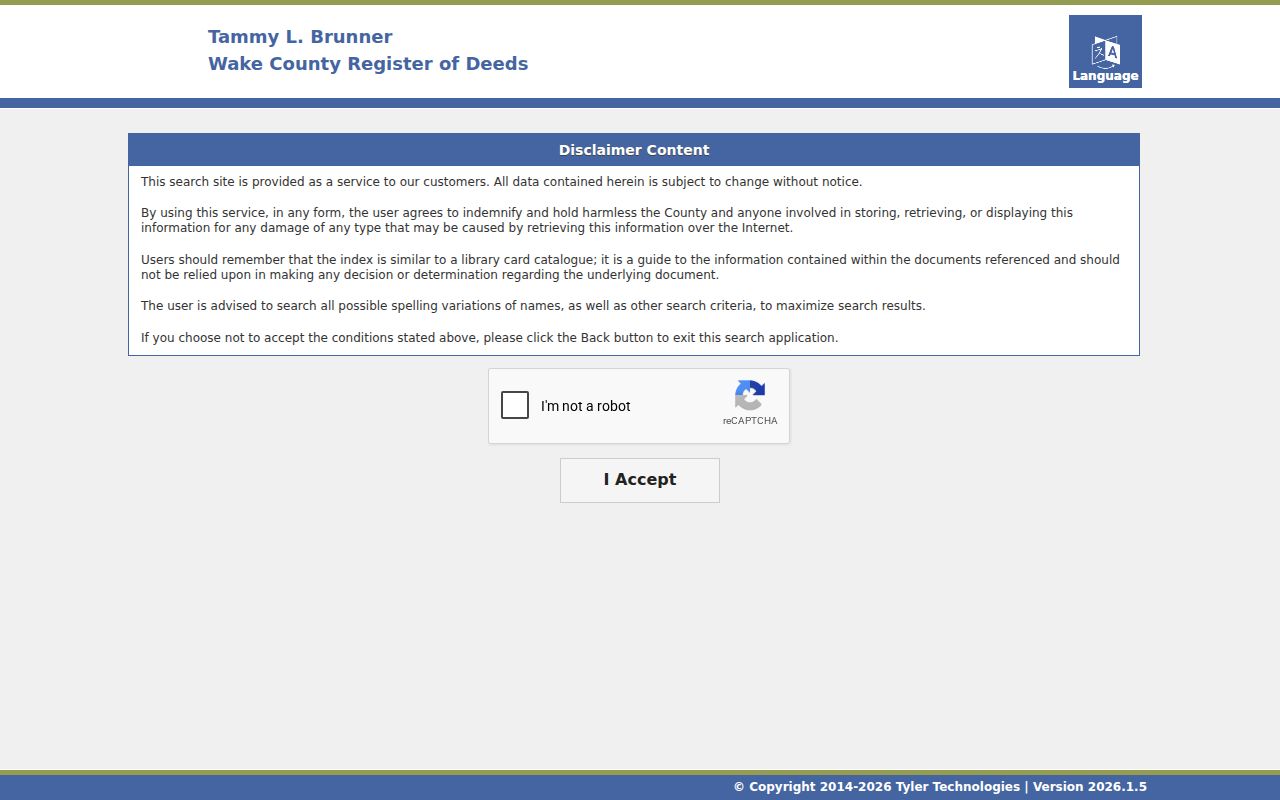
The screen makes clear why a name or deed reference is more useful than a bare street address. Try every sound spelling and inspect the image before treating an indexed party as a current owner.
Turn a Raleigh Address into Names
Wake Real Estate Property Search accepts an owner name, street address, seven-digit Real Estate ID, or parcel PIN. A parcel card can show owner names, the owner mailing address, the physical or situs address, deed and map references, values, and jurisdiction. Situs means the parcel’s physical location. It does not prove that the named owner lives there now.
Use the Wake real estate search to see the separate owner, address, REID, and PIN paths.
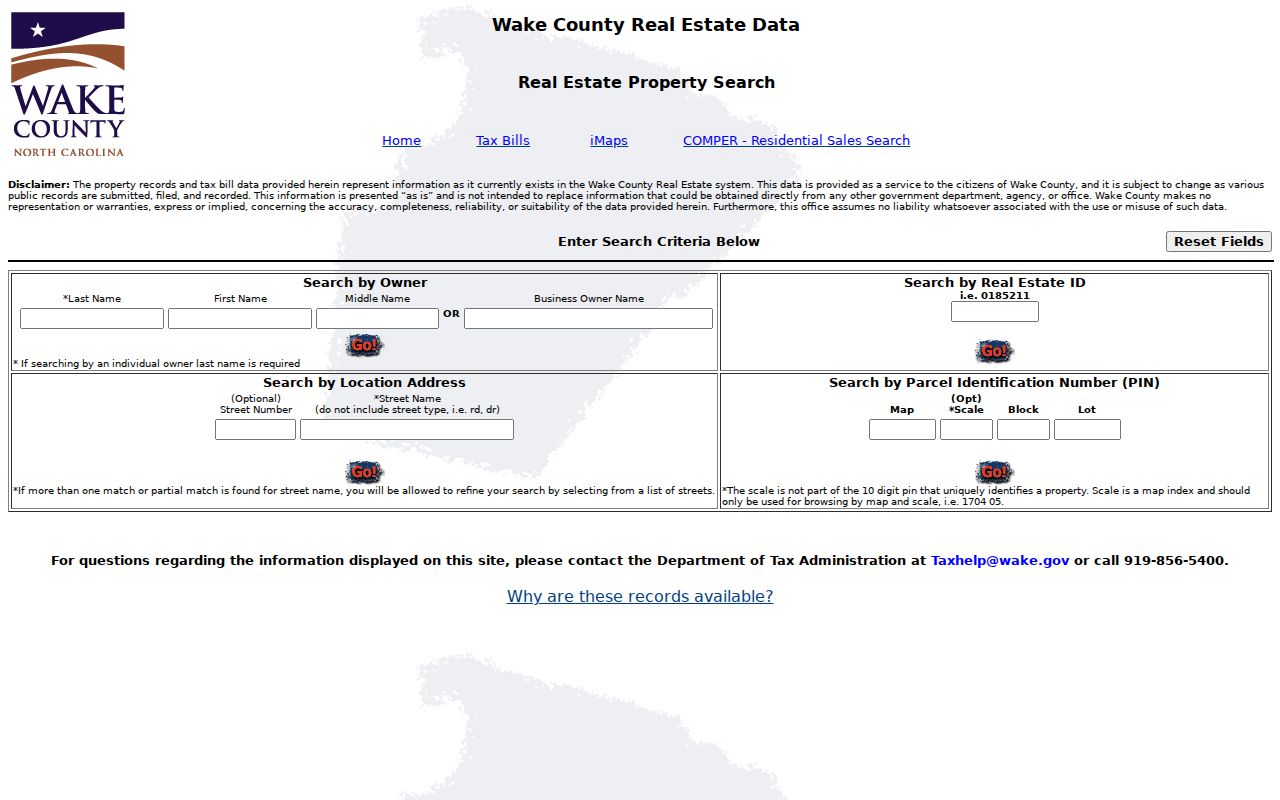
A result can supply the exact keys needed for the deed index and iMAPS. In address mode, enter the street name without a type such as Road or Drive; the number may be omitted. Tax bills add a dated owner or account trail from 1994 to the present, with email and counter help when the online copy is not enough.
| Source | Name or place evidence | Best next step |
|---|---|---|
| Real estate account | Owner, mailing address, situs, REID/PIN | Open deed and map links |
| Recorded instrument | Parties, record date, book/page, legal description | Trace prior and later instruments |
| Tax bill | Named account and billed property | Compare the bill year with ownership dates |
Map Raleigh Search Geography
A postal line that says Raleigh does not prove the parcel is in Raleigh city limits. Some properties are in the city’s extraterritorial jurisdiction, or ETJ. They remain outside the city while Raleigh applies certain zoning and building rules. That distinction decides whether a municipal department or Wake County alone is likely to hold the next record.
The Raleigh and Wake iMAPS viewer searches an address, owner, PIN, or REID and adds parcel, zoning, district, and civic-service context.
The parcel result can bridge a street to tax data, recorded deed references, a building photo, and government geography. Historic aerial imagery reaches back to 1981 in the City’s app description, which can help place a road or subdivision that changed during Raleigh’s growth.
The City’s map gallery adds city-limit, planning-jurisdiction, and annexation-history choices.
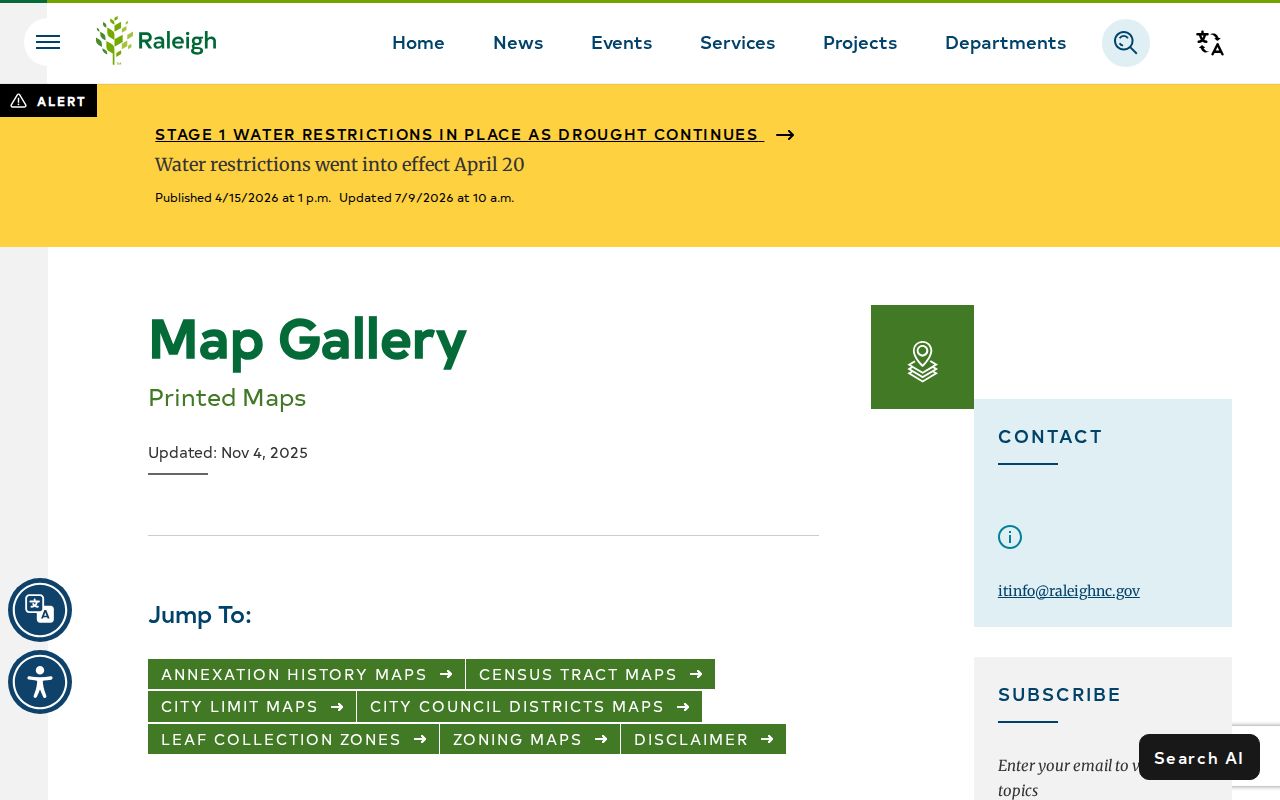
Those maps explain why an older Wake County address may later appear in Raleigh permit or council records. Search both jurisdictions around an annexation date instead of assuming the custodian stayed the same.
Find Raleigh Court Records by Name
Raleigh has no separate municipal court. Wake County District and Superior Courts handle ordinary state civil, criminal, family, estate, and special-proceeding matters. Start in the statewide eCourts Portal with a full party name and Wake County filter. Confirm the case number, role, type, filing date, status, and associated counsel before relying on a namesake match.
The Portal’s case summary and Register of Actions are near real time but are not the official court record. Public document links vary. Older papers may exist only in the clerk’s file, while sealed, expunged, juvenile, and adoption material stays restricted. The Wake Clerk, not the statewide administrative-record form, supplies pleadings, judgments, and certified copies from a Wake case.
| Court channel | What it covers | Access |
|---|---|---|
| eCourts Portal | State case names, numbers, events, hearings, and eligible documents | Free public web search |
| Wake clerk terminal | Criminal, civil, estate, and special-proceeding information | In person at a clerk office |
| Wake paper file | Filed pleadings, orders, judgments, and certified copies | Inspect or request from the clerk |
| Eastern District of N.C. | Federal cases filed in the Raleigh division | PACER account and federal fee rules |
Note: Civil files are served at the Wake County Courthouse, while criminal matters and marriages are handled at the Wake County Justice Center.
Use Vital Records in Raleigh Searches
Wake Register of Deeds is the practical first stop for Wake marriage certificates and North Carolina birth or death certificates it can issue. North Carolina Vital Records handles statewide searches, amendments, divorce certificates, and specialized cases. A Wake certificate costs $10. The state charges a nonrefundable $24 search for one three-year period, including one certificate if found, and $15 for another copy of that same certificate.
Certified copies are not an open name database. G.S. 130A-93 limits them to the subject and listed relatives, representatives, agents, and people with a qualifying legal interest. The rule is based on fields, copy type, and eligibility, not a simple century cutoff. The county accepts an application with photo identification online, by mail, or at the Justice Center counter. The state offers its own portal and mail form.
Historical research follows a different route. Olivia Raney catalog records identify Raleigh birth registers for 1890 through 1938 and a death register for 1887 through 1937. State Archives indices, county register volumes, obituaries, and estate files can extend that trail without treating the modern certificate service as a people directory.
Search Raleigh City-Created Records
Municipal records matter when the event involved Raleigh government. Council and board minutes may name speakers, appointees, or applicants. Permit, inspection, occupancy, zoning, and code files may connect a person, project, business, or address. Raleigh Open Data includes zoning, permits, unclaimed checks, and other city-created sets.
The Raleigh Development Records entry point shows which permit and code details are available before a request is filed.
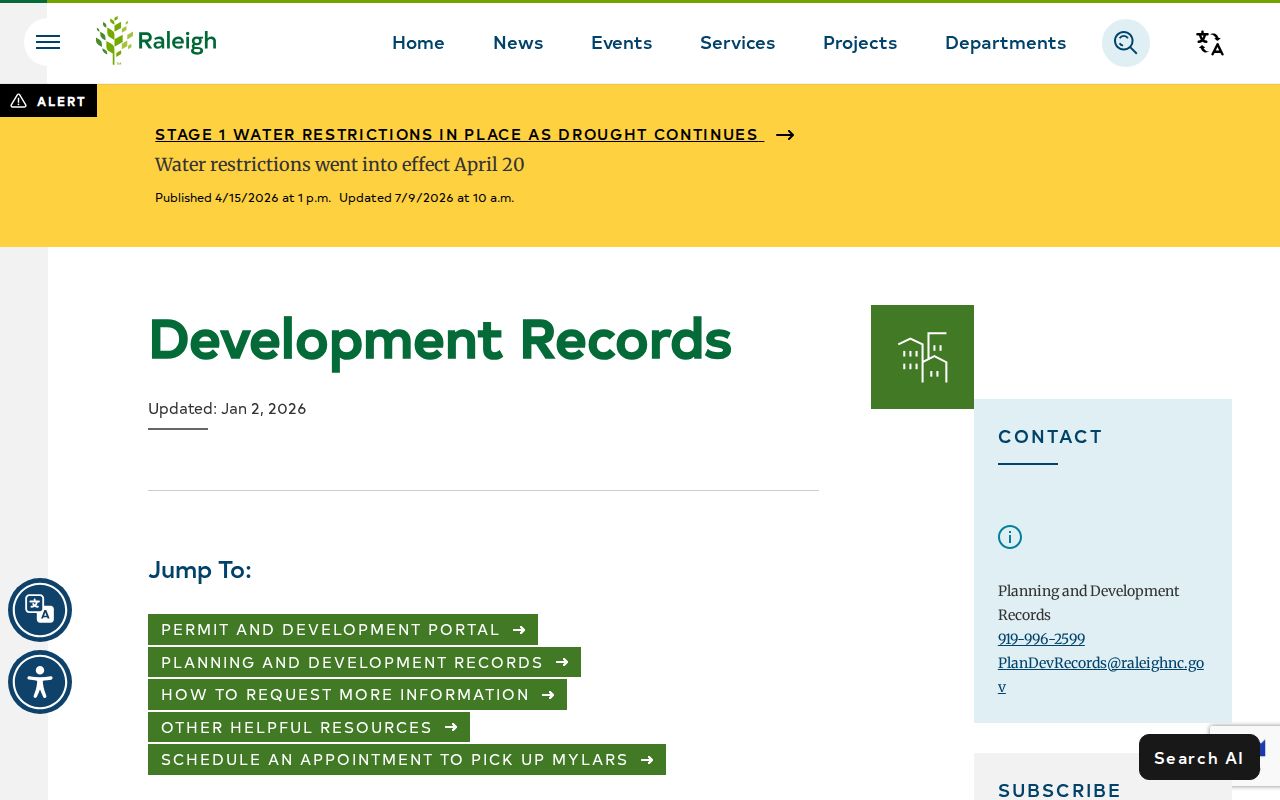
New Administrative Site Review, recorded map or plat, and subdivision cases beginning January 1, 2025 use the Permit and Development Portal. Earlier cases remain in annual tables. Search by case number, project name, or address, then ask for building plans and attachments that the portal does not expose.
The City records request page routes users to self-service records and the public-record portal.
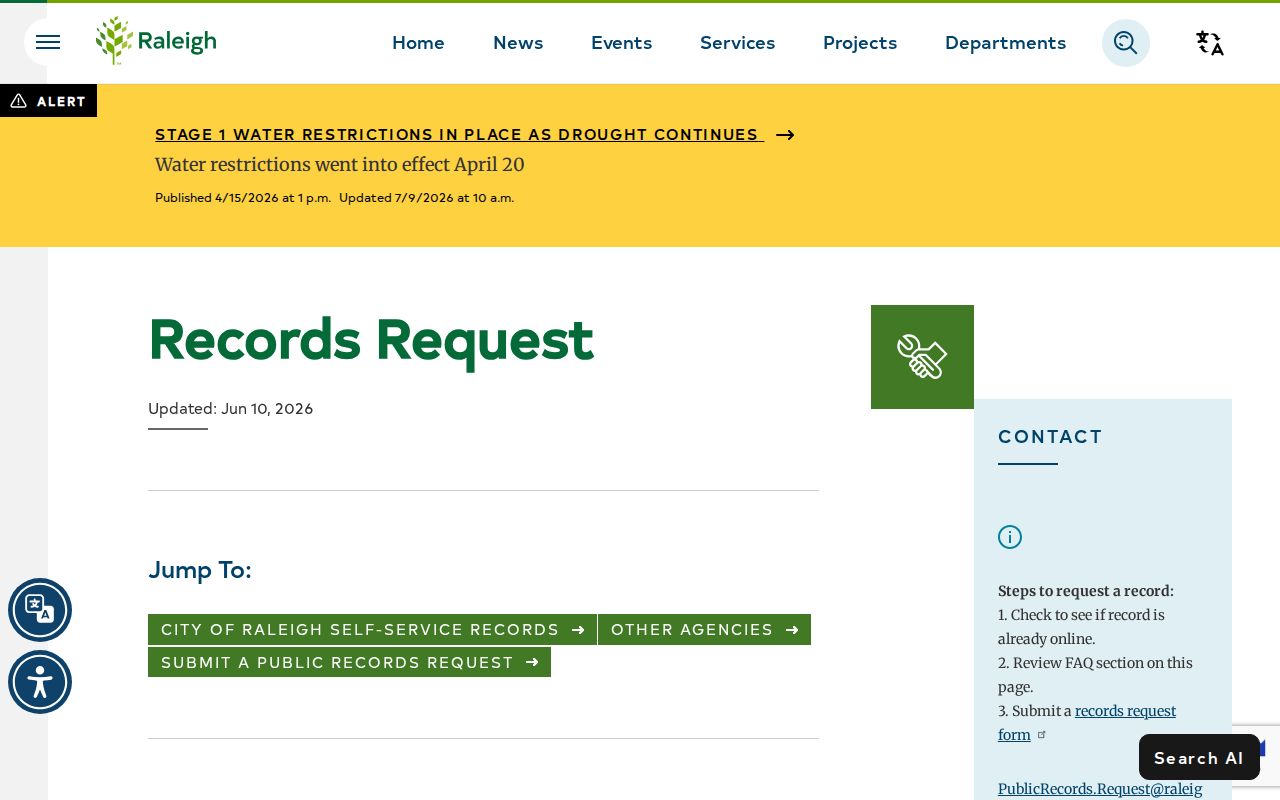
Requests are processed in receipt order, with status updates through the portal. Give the department, record type, address or case number, and date range. Raleigh states no universal completion time, and a complex or legally reviewed request can take longer.
Search Raleigh Public Staff Contacts
The City staff directory is an official route to a public-facing contact, not a resident list. It searches first name, last name, and department. Use it when a permit, planning case, council item, or records request identifies a Raleigh department but not the staff member who can explain the public process.
The Raleigh staff directory presents those three search fields. A result can provide an employee name, department, and public contact information. It should be read as an agency-contact record. The directory does not identify private Raleigh residents or replace a request for the underlying municipal file.
Trace Raleigh Families at Olivia Raney
Olivia Raney Local History Library holds sources that current portals cannot replace. Raleigh city-directory holdings include editions from 1880–81, 1887, 1891, 1896–97, 1899–1900, and 1907–08, plus later Polk and Hill volumes. The catalog does not promise a complete annual run, so ask staff which years and street-arranged sections are available.
A directory can work in two directions. The alphabetical section moves from surname to an address. A later street or reverse section moves from an address to occupants. Check adjacent editions because a canvass or publication date may lag a move.
The Olivia Raney Raleigh city-directory record displays the cataloged title and item-level holdings. The collection is built for on-site research. Many items are noncirculating, reference-only, or on microfilm. Plat maps cover 1885 to 1950 with an index through 1981, while guardians’ accounts span 1817 to 1947. Those accounts can reconnect minors, guardians, estates, and property across generations when a standard household listing disappears.
Follow Raleigh Heirs and Estates
A deceased person’s Raleigh trail often splits between an obituary and the Wake Clerk. Newspapers may supply relatives, churches, schools, and former addresses. An estate file can identify a personal representative, heirs or devisees, lawyers, creditors, and property. Devisee means someone who receives property through a will. The two sources support each other but do not prove the same facts.
Start with a name and date in digitized Wake newspapers or a city directory. Search eCourts and courthouse terminals for the estate or related special proceeding. Use parcel and deed references to trace land, then consult guardians’ accounts when minors or long-running family property are involved. The State Archives county guide covers transferred estate, will, court, land, tax, school, and election series in original or microfilm form.
- Index
- A finding tool that points to a record. It is not the record itself.
- Docket
- The dated list of filings and events in a court case.
- Certified copy
- An official copy authenticated by the custodian, often for a set fee.
- Plat
- A recorded map that shows lots, streets, boundaries, or a subdivision.
Check Raleigh Voter Records Briefly
The NCSBE Voter Search can add dated residence, registration status, party, precinct, district, polling place, and participation history to a Raleigh name search. It never reveals ballot choices. Birth date, Social Security number, and driver-license number are excluded from public voter files. A person who moved counties, changed a name, or entered a protected-address program may require a different official route.
Wake County administers local registration while the state runs the individual lookup and downloadable files. Search by first and last name, use birth year when helpful, and apply the Wake filter with care. For an older Raleigh resident, relax the county filter and check removed or denied records where the search offers that status. The complete field, file, and confidentiality treatment is on the Raleigh voter records page.
Search Raleigh Business and License Records
North Carolina Secretary of State filings can connect a Raleigh name with an entity, registered agent, office address, organizer, annual report, or UCC filing. Those roles have distinct meanings. A registered agent accepts legal papers, and an organizer files formation documents. Neither label alone proves ownership.
For a regulated occupation, NC BOLD routes the search to the issuing board. Board portals may show a name, credential number, status, issue or expiration dates, and public discipline. Search the exact board named in the official directory because there is no single Raleigh license roster. Save the credential number and verify status at the source rather than relying on a copied listing.
Official filings are strongest when compared with other dated evidence. An entity address may be a law office or service address. A professional record may be current while an older directory entry is not. Match names with dates, roles, parcel or case keys, and known middle initials.
Read Raleigh Custody Records Carefully
Custody and offender systems serve different scopes. Wake County handles local detention and arrest records. The N.C. Department of Adult Correction searches prison offenders, probationers, and parolees by name or offender ID. The state registry supports name and address searches for registrants. Federal custody uses the Bureau of Prisons locator, not a Wake or state tool.
A DAC result may include committed and alias names, offender number, supervision status, sentence information, dates, and current or prior locations. Internal behavior and classification records remain confidential. Treat a name-only result cautiously, and do not treat an arrest as a conviction.
Wake County announced that online mugshots and daily arrest reports will stop on August 17, 2026 because automated expunctions can leave old web publication inaccurate. Daily arrest records will remain at the Public Safety Center desk. Current custody should be checked with the holding agency, while filed charges and dispositions belong in eCourts or the Wake clerk file.
Keep Raleigh Searches Lawful
Open access is not permission to stalk, threaten, impersonate, or defraud. Use public records for lawful family, estate, consumer-safety, civic, historical, and property research. Do not try to defeat a sealed case, adoption restriction, protected voter address, or redaction. A missing address can be the correct result.
Legal limit: Never use Raleigh records to monitor, harass, threaten, or harm another person. Respect court seals, safety programs, and protected identifiers.
North Carolina’s Address Confidentiality Program gives eligible survivors a substitute address and mail forwarding. State and local offices must protect the actual residence under Chapter 15C. A participant can also protect a voter residence address through the county elections board. Commercial search products may keep stale or merged entries, while removing a search-engine result does not delete the official source record.
Continue a Raleigh Search Offline
Not every Raleigh record is online, and an online index may expose less than the file. Change channels when the first tool fails. Courthouse terminals can reach criminal, civil, estate, and special-proceeding information. The Wake Clerk retrieves paper files and makes copies. The Register of Deeds accepts recorded-document copy requests by mail or at the counter. City staff route permit attachments and municipal files through the public-record portal.
For older people, the fallback moves to Olivia Raney, the Government and Heritage Library, and the State Archives. Catalog descriptions may name a series but not the people inside a volume or box. Bring dates, name variants, addresses, book/page references, REID or PIN values, and case numbers. Archives deed-copy requests require book and page, and research fees can depend on residence and service.
- Office counter or terminal: use it when the web index is thin or the file is not imaged; bring a name, date range, and case or parcel key.
- Written records request: use it when a city or agency record is not self-service; identify the custodian, existing record type, dates, and desired format.
- Library or archives: use these when the trail predates current portals; bring names, variants, addresses, and any series or volume references.
- Certified-copy application: use the dedicated form when proof-quality deed or vital evidence is needed; supply the record identifier, ID, relationship, and current fee.
A government index and a commercial people-finder serve different purposes. Official files have known custodians, field definitions, and copy routes. Commercial compilations may help form a lead, but they can merge names and lag changes. Confirm any important fact with the office that holds the source record.