
Raleigh Public Records Coverage
Access turns on the record's custodian. Raleigh departments keep city council, planning, permit, code, police, and city-created open-data files. Wake County keeps recorded land instruments, local property taxes, Wake certificates, and most trial-court files. North Carolina agencies run statewide voter, business, license, correctional, and vital-record systems. The same name can appear in several systems, but each entry proves only the event or relationship that its keeper recorded.
| Raleigh record set | Official keeper | Remote access | Other channel |
|---|---|---|---|
| Deeds, deeds of trust, liens, plats | Wake Register of Deeds | CRPI index and available document images | Counter or mail copy request |
| Property ownership and tax | Wake Tax Administration | Real Estate Search; tax bills from 1994 to present | Email, phone, or counter |
| Civil, criminal, estate, special proceedings | Wake Clerk of Superior Court | State eCourts Portal | Clerk terminal, paper file, copies |
| Birth, death, marriage, divorce proof | Wake Register of Deeds, Wake Clerk, N.C. Vital Records | Ordering services, not a full open name index | Application, ID, mail, or counter |
| Raleigh permits, boards, and city files | City department that created the record | Self-service systems and city request portal | Email assistance or city request |
| Custody and offender information | Wake Public Safety, N.C. DAC, N.C. SBI | System-specific public tools | Records desk or agency request |
Open status does not mean every field is disclosed. Sealed and expunged cases, juvenile and adoption material, protected addresses, defined personal identifiers, and parts of criminal investigative files remain closed or redacted. Certified vital copies have separate eligibility rules. The focused voter-record route is described with its own confidential-field rules in Raleigh voter records.
Raleigh Deed Records Index
The Wake Register of Deeds calls its Consolidated Real Property Index a catalog of indexed information and digital images. It is not an address directory or a legal opinion. A grantor gives or encumbers an interest, while a grantee receives one. Search all spelling variants, then read the instrument itself. An indexed name alone does not prove current ownership. The exact beginning year of online coverage was not stated on the official pages inspected.
| CRPI field | Input | Required | Format or choice |
|---|---|---|---|
| Search Type | Dropdown | No | Standard or Sounds Like |
| Grantor / Grantor Type | Two text boxes and dropdown | Conditional | Last name, first name, or firm; at least 3 characters; human, firm, or both |
| Grantee / Grantee Type | Two text boxes and dropdown | Conditional | Same name format and type choices |
| Recorded date range | Date text or calendar | Conditional | mm/dd/yyyy |
| Book and Page | Text | Conditional | Book needs 4 characters; maps use BM plus year, condo maps CM plus year |
| Search | Button | Yes | Supply a party, date range, or book/page |
The Wake recorded-document index opens through a terms screen before its search. The captured portal shows that official entry point.
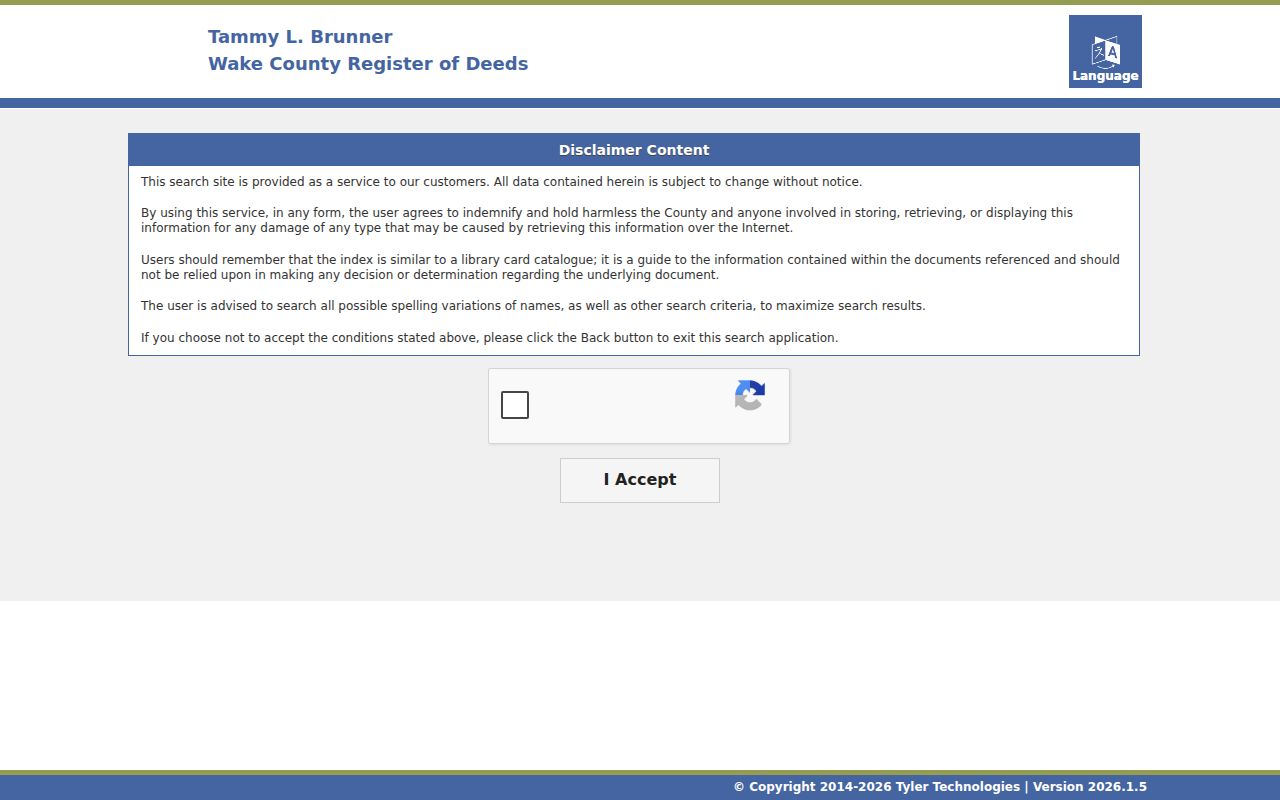
Once inside, results can identify parties, instrument type, record date, and book/page or document ID, with an image link when available. Certified copies use the recorded-document request form and cost $5 for the first page plus $2 for each added page.
Raleigh Property Records Geography
Wake's Real Estate Search and iMAPS answer different questions. The tax system can search an individual owner, business owner, seven-digit REID, street address, or PIN components. Its parcel card can show owner and mailing address, situs address, deed and map references, assessed value, jurisdiction, and property traits. “Situs” means the land's physical address. A mailing address belongs to the tax account and does not prove that the owner lives there.
iMAPS adds parcel shape, nearby land, and jurisdiction layers. This matters because a postal address with “Raleigh” can fall outside Raleigh's city boundary. Check the parcel and jurisdiction before asking a city department for a county-held file. A concise trail is: street address to parcel, parcel to current owner, deed reference to recorded instrument. The deeper access-law distinctions remain with these official custodians, while Raleigh people directories compares name directories by what they list.
The Wake Real Estate Property Search provides the owner, address, REID, and PIN search choices used for Raleigh property records. Its data reflects the live tax system and changes as source records are filed. Confirm a question about the originating instrument with the Register of Deeds.
Note: Wake's online tax-bill search reaches from 1994 to the present; vehicle-tax statements paid through DMV are not on the county site.
Raleigh Court Records Channels
Wake trial-court files belong to the Wake Clerk of Superior Court. The statewide eCourts Portal offers Smart Search, hearing, judgment, and transcript searches. A full party name plus a Wake filter helps reduce namesake errors. A case summary may show number, court, parties and roles, case type, filing date, status, hearings, event history, and eligible public documents. It is near-real-time information, not the official court record.
Use the courthouse terminal when the web record is too thin. A terminal in any county clerk's office can search criminal information by defendant, case number, or victim or witness name. Civil, estate, and special-proceeding information is also available through clerk terminals. Inspect the paper file in Wake when an older pleading is not imaged, and ask the clerk for a certified order or judgment. The state Judicial Branch administrative-record form does not supply county case documents.
Raleigh has an unusual building split. Civil matters other than marriages are at the Wake County Courthouse, while criminal matters and marriages are handled at the Wake County Justice Center. That division affects where a person goes for a paper file or payment.
Raleigh Vital Record Restrictions
Vital certificates do not follow the ordinary Chapter 132 request path. The Wake Register of Deeds issues North Carolina birth and death certificates and Wake marriage certificates for $10 each. The state route charges a nonrefundable $24 search for one three-year period, including one certificate if found, and $15 for another copy of the same certificate. Wake's form requires the event facts, requester details, signature, a government photo-ID copy, and a qualifying relationship for a certified copy.
North Carolina does not use a simple “birth closed 100 years” or “death closed 50 years” rule. G.S. 130A-93 is field- and copy-based. It removes specified birth identity details from public status and limits certified copies to the subject, certain relatives, people establishing personal or property rights, and authorized representatives. Adoption records and other protected categories have added limits.
Wake accepts the certificate application online, at the Wake County Justice Center counter, or by mail to the Register of Deeds, Attention Vital Records, PO Box 1897, Raleigh, NC 27602-1897. The state also accepts its signed form by mail at North Carolina Vital Records, ATTN: VC Certificate Orders, 1903 Mail Service Center, Raleigh, NC 27699-1900. Never send cash with the state order.
The N.C. Vital Records service portal provides the state certificate-service channel shown here.
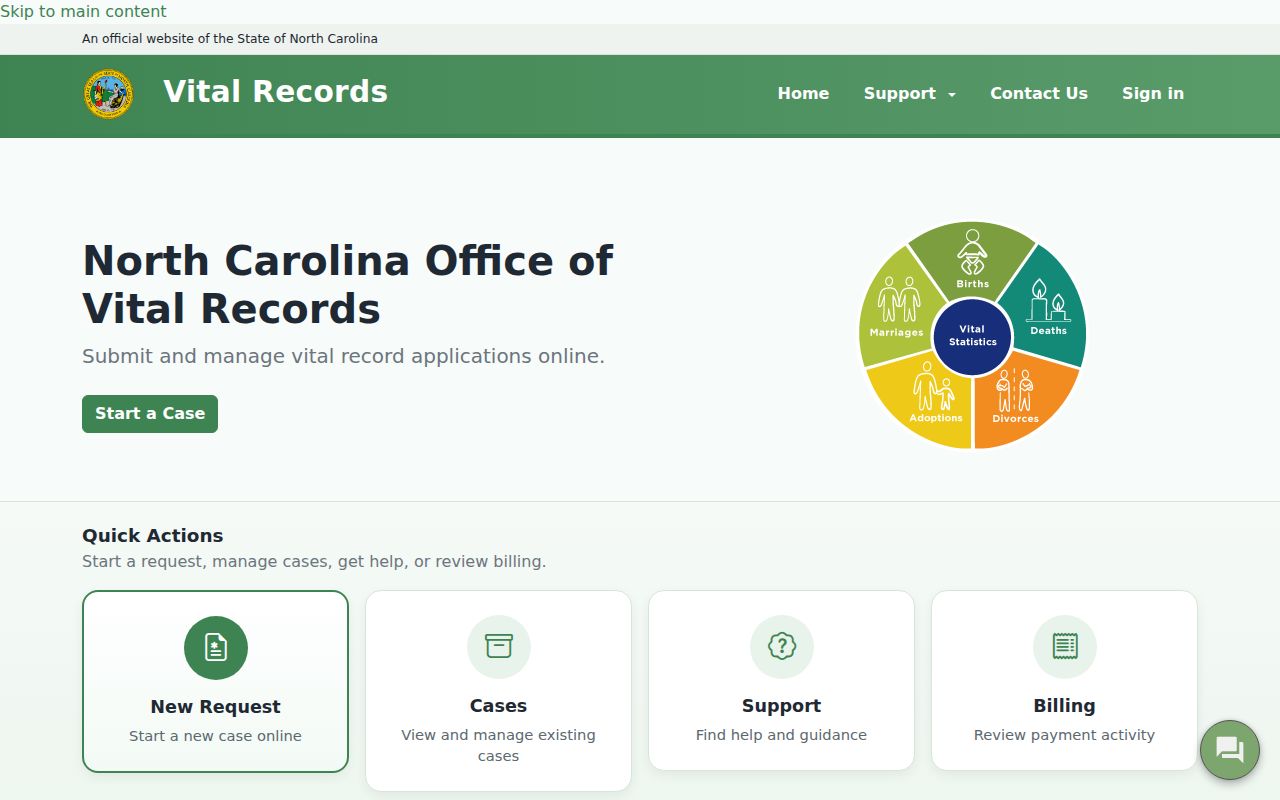
The screen is an order and case-service route, not an open Raleigh name index. Historical family research belongs in authorized archives, county volumes, and cataloged record series.
Raleigh Custody Registry Records
Custody information is split by agency. The N.C. Department of Adult Correction tool searches prison offenders, probationers, and parolees by name or offender ID. Results may connect committed and alias names with offender number, status, demographic details, incarceration or supervision facts, sentence history, movement, and release information. Internal behavior and classification records remain confidential. The N.C. SBI registry supports name, alias, address, map, and notification searches, but its public status never permits threats or harassment.
Wake's publication channel is changing. Daily arrest records will remain available at the Public Safety Center desk after online mugshots and daily reports end on August 17, 2026. Wake cited the risk that automated expunctions could leave old web material inaccurate. Use the desk for the arrest entry, local public-safety staff for current custody, and the Clerk or eCourts for filed charges and dispositions. An arrest is not a conviction.
Raleigh Public Records Offices
The correct office depends on the record, not the portal a requester happens to know. These Raleigh counters cover the main county systems. Hours and operating details can change, so confirm them with the linked custodian before a visit.
Wake Register of Deeds
Wake County Justice Center
300 S. Salisbury St., Suite 1700
Raleigh, NC 27601
919-856-5476
Wake Tax Administration
301 S. McDowell St., Suite 3800
Raleigh, NC 27601
919-856-5400
Wake Real Estate Search
Wake Clerk of Superior Court
Wake County Courthouse
316 Fayetteville Street Mall
Raleigh, NC 27601
919-792-4000
The City of Raleigh uses self-service council, board, open-data, permit, and development systems first. If the city-created record is not online, the city records request route sends status updates, and PublicRecords.Request@raleighnc.gov provides help.
Raleigh Records Fees Explained
G.S. 132-6.2 generally limits an uncertified copy to direct reproduction cost when no other law sets the fee. A reasonable special service charge may apply when a request takes extensive technology, clerical, or supervisory work. Ask for an estimate. Clerk copies, certified recorded documents, and vital certificates follow their own statutory or published schedules instead of the default actual-cost rule.
- Index
- A finding aid that points to a record. It may not contain the full paper.
- Image
- A scan of the recorded or filed document, sometimes with exhibits.
- Certified copy
- A copy bearing the custodian's formal certification for proof-quality use.
- Custodian
- The office legally responsible for keeping and releasing the record.
- Exemption
- A law that closes a record or field despite the general access rule.
Inspection and many online searches are free. Wake's recorded-document form lists $5 for the first certified page and $2 for each next page. The current court fee chart should be checked rather than relying on an old per-page amount.
Raleigh Protected Record Limits
Chapter 132 is broad, but narrower privacy statutes control. G.S. 132-1.10 protects Social Security numbers and other defined identifiers, while allowing release of an otherwise open record after those fields are removed. Court orders and specific laws protect sealed, expunged, juvenile, and adoption files. Motor-vehicle data follows the federal DPPA and G.S. 20-43.1, not the ordinary public-record route.
The N.C. DOJ Address Confidentiality Program gives eligible survivors a substitute address and mail forwarding. State and local agencies must protect the actual residence, subject to statutory exceptions. A protected voter can present an authorization card and signed safety statement to the county elections board, leaving the residential address confidential while name, precinct, and other registration data remain public.
Lawful personal use. Public access is not permission to stalk, threaten, impersonate, defraud, or evade a protected system. G.S. 14-277.3A imposes criminal penalties for stalking conduct.
Request Raleigh Open Records
North Carolina Public Records Law permits inspection at reasonable times by any person and calls for copies “as promptly as possible.” It sets no universal number of response days. A custodian may satisfy access by placing a printable or savable record online, and an agency need not create a report or answer a question that does not already exist as a record.
- Confirm jurisdiction. Use parcel and GIS fields when a Raleigh mailing address may be outside the city boundary. Choose the city, Wake County, court clerk, or state agency that made the record.
- Search first. Save a book/page, REID, PIN, case number, license number, or other stable identifier from the public index.
- Describe the record. Give names and variants, a date range, address, record series, identifier, and desired electronic or paper medium. Ask for an existing record.
- Use the right route. Send city files through Raleigh's portal, filed court papers to the Wake Clerk, and restricted certificates through the dedicated vital application.
- Resolve cost and redaction. Ask for an estimate and request releasable portions when some fields are exempt.
- Address a denial. Ask for the legal basis in writing. G.S. 132-9 supplies an enforcement route, generally after mediation.
The Judicial Branch administrative-record form shows the requester, contact, address, and records-description stages for NCAOC-held material.
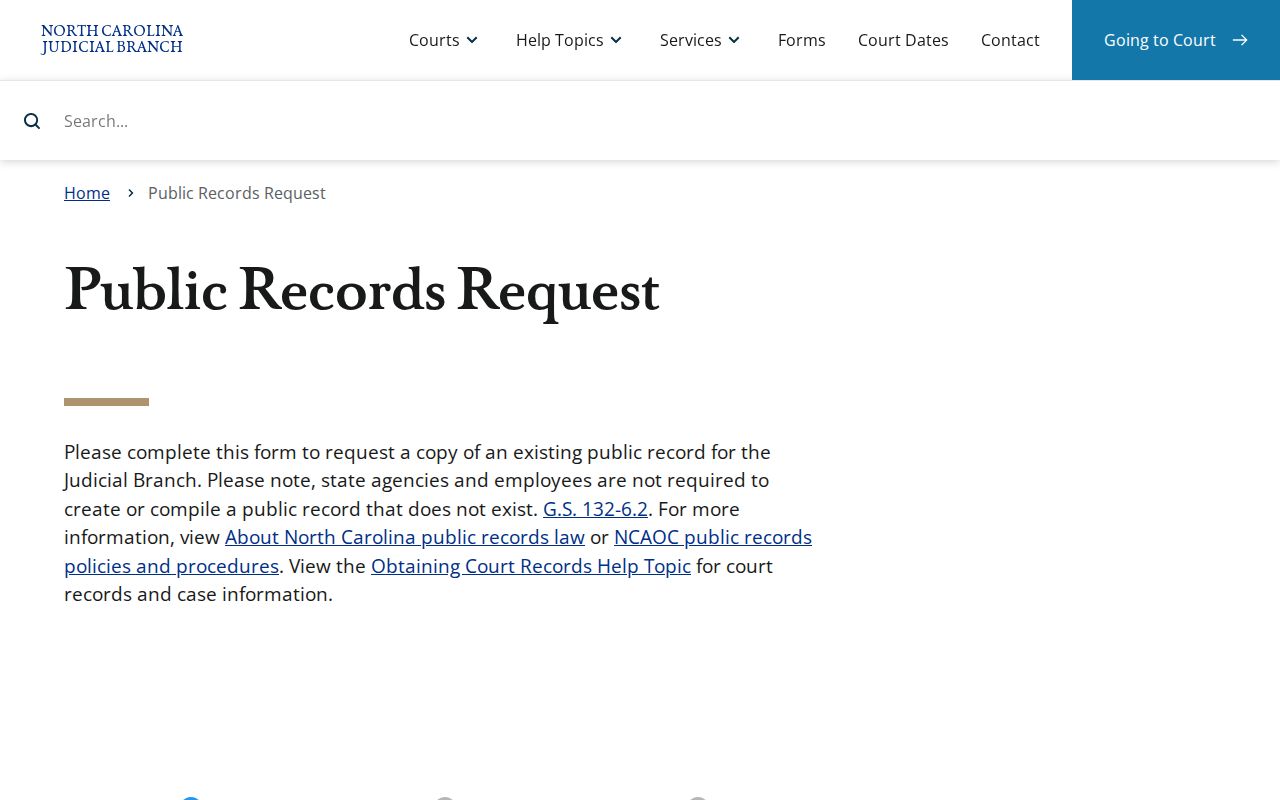
The form expressly does not replace the Wake Clerk for pleadings, orders, judgments, or case information. That custodian distinction prevents a valid request from being routed to an office that does not hold the file.
Raleigh Archives Preserve Records
When a portal has no scan, move to the State Archives county-record channel. Its Wake groups include courts, estates, land, marriage and vital statistics, elections, schools, taxes, wills, military and pension files, and other county series. The Wake miscellaneous collection spans 1772 through 1952. Original and microfilm holdings vary by series and transfer history.
The Archives copy form needs a deed book and page. It lists estates, wills, and death certificates among its search categories and states a $20 per-record research fee for non-North Carolina residents. Those ranges describe statewide form categories, not complete Wake coverage. For local family history, pair archival series with Wake library catalogs instead of treating a modern certificate-order service as an open historical index.