
Raleigh People Directory Landscape
Raleigh people directories are split by purpose. A government staff listing identifies a public work contact. A campus directory ties faculty or staff to a department. Wake County tax and deed systems list people because they own land or appear in a recorded instrument. Business and license systems show filed or credentialed roles. Older residents are found through printed city directories, newspapers, yearbooks, maps, and archival books.
No official source lists every Raleigh resident. Access also varies. Current government, campus, parcel, deed, and license directories can be searched online. School contacts are published one school at a time. No authoritative comprehensive current Raleigh phone directory was verified, though government and campus entries may publish official work numbers. Many Olivia Raney Local History Library items are noncirculating, while State Archives materials may require a catalog search, research-room visit, or copy request.
| Raleigh directory | People or roles listed | Official keeper | How to use it |
|---|---|---|---|
| City staff directory | Public-facing city employees and departments | City of Raleigh | Free name or department search |
| State employee directory | North Carolina agency personnel | NC.gov | Free name and agency search |
| NC State Campus Directory | Faculty and staff; students with authentication | NC State University | Public faculty/staff search |
| Wake real estate and deed indexes | Parcel owners and recorded-document parties | Wake County | Free owner, parcel, or party searches |
| Professional directories | Licensees and public credential status | North Carolina boards | Board-specific online verification |
| Raleigh city directories | Past residents, businesses, and addresses | Olivia Raney Local History Library | Catalog first; many items onsite |
Choose the directory by the relationship being tested. For a city worker, search the city or department. For an address, begin with the Wake property roll. For a past household, move to printed Raleigh volumes and newspaper collections. A result proves only what that directory was built to record.
Raleigh Government Contact Directories
The City of Raleigh staff directory page accepts a first name, last name, or department. It is meant to locate a public-facing work contact, not a resident, and the research did not verify that it covers every municipal employee. The general City line, 919-996-3000, is the fallback when a person is absent or the right department is unclear. Department pages, council rosters, and board or commission pages provide another route for named officials.
- First Name
- An optional text field that can be used alone or with another criterion.
- Last Name
- An optional text field for a public employee surname.
- Department
- An optional dropdown that limits results to a city unit.
- Search
- The button submits whichever criteria were selected.
The directory page itself shows how spare the query can be. View the official Raleigh staff search before entering a name.
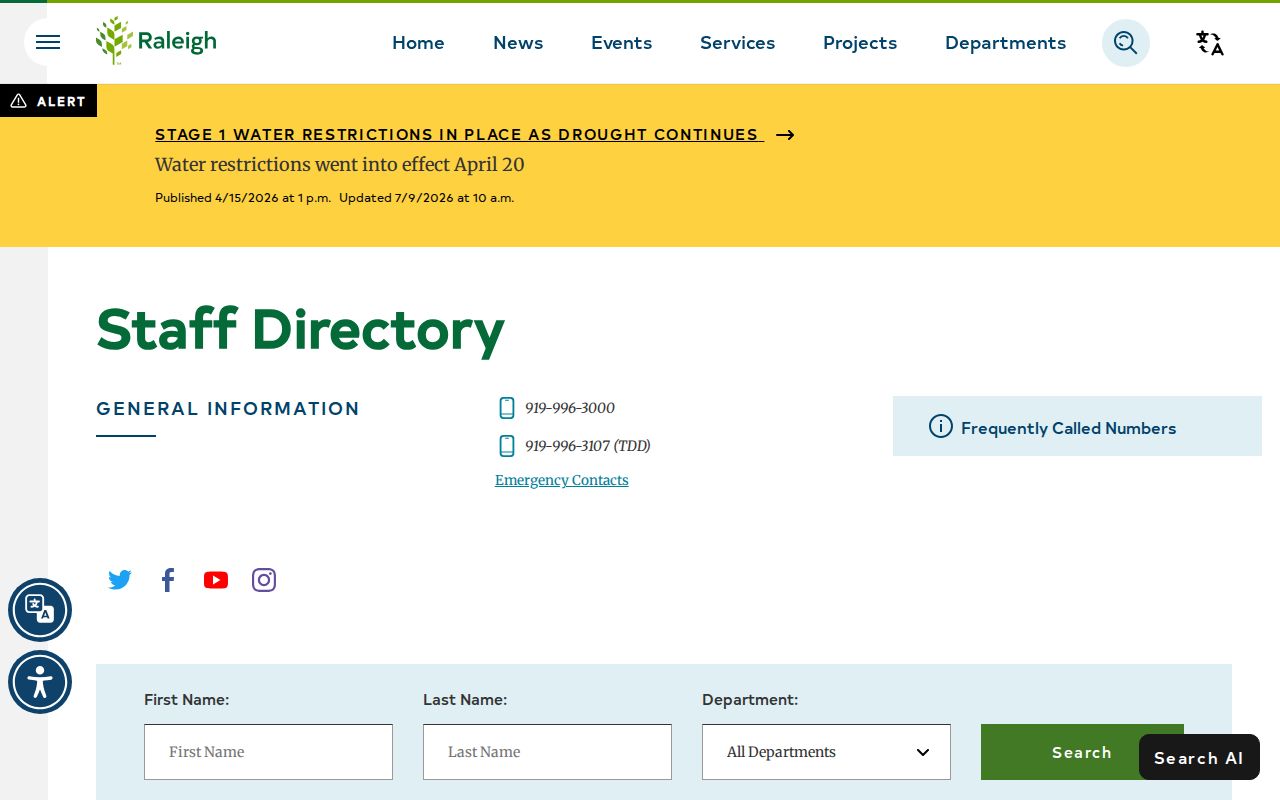
The captured search screen confirms the first-name, last-name, and department controls used to narrow a public contact.
The North Carolina employee directory matters more here than in many cities because Raleigh is the state capital. It searches first or middle name, last name, and agency. Entries are primarily drawn from the state’s BEST personnel system, while official email data comes from NCID. Wake County’s department directory is a route to offices and leaders, but it is not a promise that every county employee is indexed.
Typical government directory entries show a name, agency or department, work phone, and official email when published. They do not promise a home address, private email, or personal telephone.
NC State Raleigh Directory Search
The NC State Campus Directory is the richest fielded Raleigh directory found in the research. Public users can search faculty and staff by name, email, campus address, phone, department, college, or working title. Results can appear in phone-oriented, address-oriented, or brief form. Student results require a Unity login, and broad searches stop at 500 results.
| Directory field | Match choices | Required | Key limit or option |
|---|---|---|---|
| Last Name | Is, starts with, sounds like | No | Previous-last-name matching is supported |
| First Name | Starts with, is, sounds like | No | Nickname matching is supported |
| E-Mail Address | Is, starts with, contains | No | Official campus address |
| Campus Address | Contains, is, starts with, sounds like | No | Campus location, not a home address |
| Phone Number | Ends with, is | No | Campus telephone |
| Department or College | Contains, is, starts with, sounds like | No | Useful for common names |
| Working Title | Contains, is, starts with, sounds like | No | Limits by public role |
| Population | All, Staff/Faculty, Student | No | Student results require login |
| Style | Phone, address, or brief | No | Controls result format |
A sample entry can contain the person’s name, faculty or staff status, official email, campus phone, campus address, department or college, and working title. A vCard option may also appear. Try “sounds like,” a nickname, or a former surname when an exact search fails. Then add the department so the result cap does not hide a common name.
Raleigh School Staff Directories
Wake County Public School System contacts are decentralized. Individual school pages publish staff directories or contact lists with names, roles, district email addresses, and phone numbers or extensions. Start by identifying the school, then open its official page. Research did not verify a single district-wide fielded portal for every teacher, so a school-by-school search is the reliable public route.
The NC Department of Public Instruction staff directory serves a different population. Its filter can search deputy, office, section, name, or status. Result columns include last and first name, title, email, phone, division, office, section, and status. It covers DPI, the State Board, NCCAT, and residential-school staff, not the full Wake school workforce. Wake Tech publishes contacts on college pages, but no equally rich central fielded search was confirmed.
Current student lists, alumni rosters, and many community school directories are restricted. For an older classmate or school connection, NC State Special Collections, DigitalNC yearbooks, and local newspaper collections are the public historical alternatives.
Raleigh Owner Directory Trails
Wake County public records function like focused people directories. The Wake Real Estate Property Search accepts owner name, location address, seven-digit Real Estate ID, or parcel PIN components. Its parcel card can show owner names, the owner mailing address, the property’s situs address, deed references, parcel identifiers, assessed value, and jurisdiction. Situs means the land’s physical location. A mailing address may be different and does not prove where the owner lives.
The Wake Consolidated Real Property Index is a second directory of names. Grantors and grantees are parties to deeds, deeds of trust, releases, and other recorded instruments. Grantor often means the person giving an interest; grantee often means the person receiving it. Search results include party role, instrument type, record date, and book/page or document identifier. Read the image before drawing a conclusion because an indexed party is not always a current owner.
For map context, iMAPS searches an address, owner, PIN, or REID and connects the parcel to zoning, jurisdiction, tax, and deed resources. A Raleigh mailing line can fall outside Raleigh city limits, so map jurisdiction decides whether a city record set is relevant. For access-law rules, copy requests, and offline office channels, use the Raleigh public records access resource.
Use parcel and deed directories for ownership evidence. Never treat an owner field, tax-mailing address, or recorded party name as proof of current residence.
Raleigh Professional Name Directories
North Carolina professional boards publish credential directories for public verification. Useful Raleigh sources include the State Bar directory, Medical Board search, Board of Nursing verification, Real Estate Commission lookup, and contractor or engineering board searches. Results typically identify a licensee, license number, status, public professional contact, and any public action the board is authorized to show.
Business directories answer a different question. The Secretary of State’s assumed-name search can filter by trade-name text, entity type, person name, filing dates, and Wake County. Business registration records can name company officials and registered agents. A registered agent is the legal contact for service, not necessarily the owner.
Use the filed role exactly as labeled. A license result verifies a credential at the displayed point in time. An assumed-name certificate links a person or entity to that filing. Neither should be stretched into a claim about a private home address or an unstated ownership role.
Olivia Raney Raleigh Directories
The Olivia Raney catalog record for Raleigh city directories identifies R. L. Polk & Co., Hill Directory Company, early Branson volumes, and Maloney directories. Verified holdings include 1880–81, 1887, 1891, 1896–97, 1899–1900, and 1907–08. The serial description also notes publication from 1982 onward, while a suburban-directory record shows 2020 and 2021 volumes. These dates are examples of holdings, not a claim of an unbroken run.
The official catalog entry is the best first look at the historic directory record and its access notes.
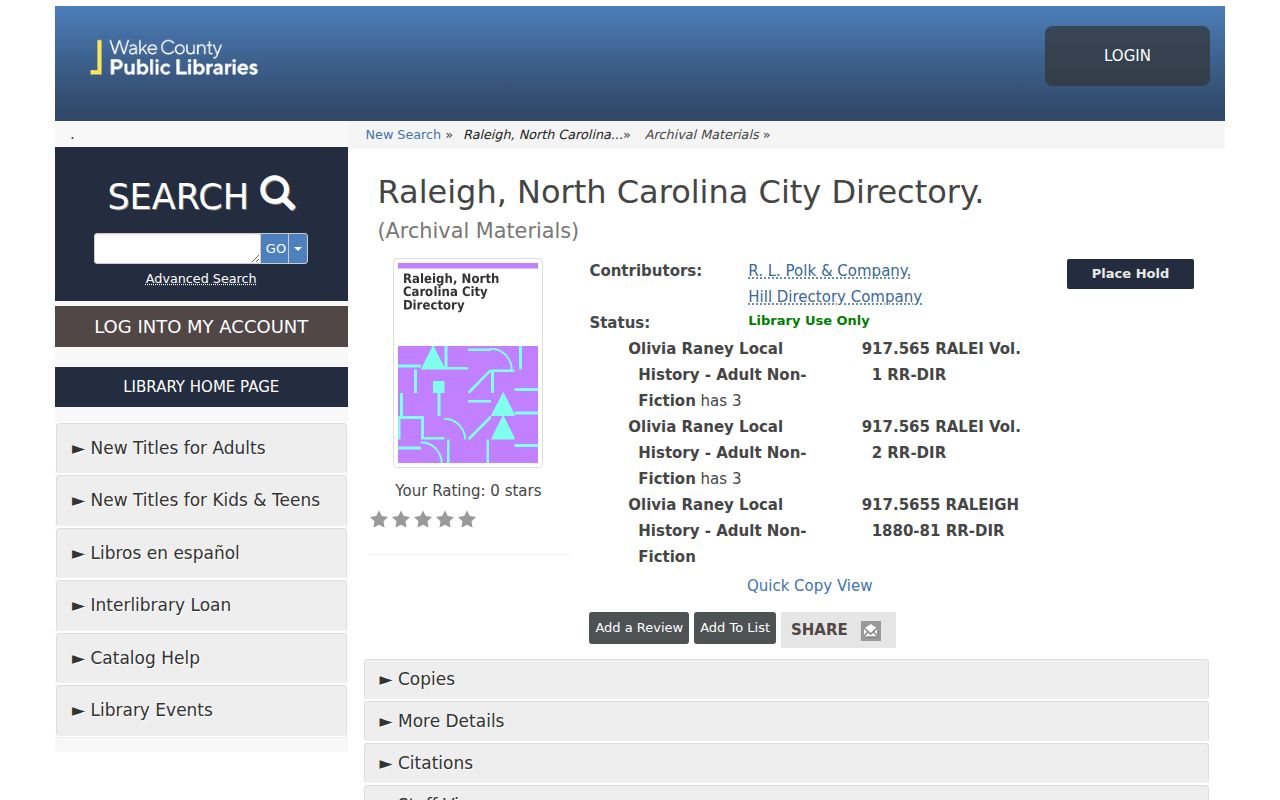
The captured record helps confirm the named publishers, item years, and local-history location before a branch visit.
| Raleigh collection point | Verified years | What it can connect | Access route |
|---|---|---|---|
| City directory items | 1880–81, 1887, 1891 | Names, firms, addresses, occupations as printed | Catalog; local-history use |
| Later early volumes | 1896–97, 1899–1900, 1907–08 | Resident and business listings | Catalog; consult staff |
| Suburban-directory items | 2020 and 2021 | Recent printed directory context | Catalog holding record |
| Official Wake plat film | 1885–1950; index through 1981 | Old subdivisions, lots, roads, and maps | Eight microfilm reels; noncirculating |
| Guardians’ accounts | 1817–1947 | Minors, guardians, estates, and property | Nine microfilm reels |
Items marked Does Not Circulate, Reference, or Microfilm/Fiche require branch use or staff help. Ask which volumes contain a street or householders arrangement. That reverse form lists an address first and can reveal who was recorded there between census years. Check nearby editions because canvassing and publication could lag a move.
Raleigh Directory Record Timeline
Raleigh’s directory trail changes form across time. Before Wake County was formed, records may fall under parent counties. Printed directories then add household and business detail, while municipal registers and plats supply other name and place links. Modern portals are useful, but none reaches backward through every layer.
- 1771
- Wake County was formed from Johnston, Cumberland, and Orange counties.
- 1880–81
- An early verified Raleigh city-directory holding appears in the Olivia Raney catalog.
- 1885
- The verified Wake official plat-map microfilm run begins.
- 1887
- A city-directory volume is held, and Raleigh’s historic death-register series begins.
- 1890
- Raleigh’s municipal birth-register series begins.
- 1981
- The Olivia Raney plat index reaches this year; iMAPS historic aerial coverage also reaches back to 1981.
Use these dates as routing points, not proof that every year survives. Earlier land and court material may be at the Register of Deeds or State Archives. Printed directories and microfilm are best handled through library staff. Recent ownership belongs in Wake’s live parcel and deed systems.
Raleigh Civic Membership Directories
The Wake County Miscellaneous Records preserve an unusual directory source: Raleigh Equal Suffrage League materials from 1914–1917 and League of Women Voters books from 1922 that list members. These are not broad resident rolls. They are focused civic membership records, valuable when a family story, signature, organization, or public role points toward local civic work.
Historical newspapers and organizational books can reconnect a civic-group name with relatives and community roles. The State Archives newspaper guide lists Raleigh titles and microfilm holdings, including the daily Raleigh Sentinel from 1865–1876. North Carolina Digital Collections and NC State Special Collections add manuscripts, campus publications, maps, and organizational records. Online descriptions often identify a collection rather than every person inside it, so an onsite search or staff request may be needed.
This is a human-use directory trail. A membership-book name can be paired with an obituary, city directory address, yearbook, or estate file to distinguish people who share a surname. It can also restore the setting around a relative’s civic life without treating a modern database as the only source.
Search Historical Raleigh Directories
Begin with the Wake County Public Libraries catalog. It supports keyword, title, start-of-title, series, author, subject, and advanced searches. Record the call number, format, branch location, and circulation note. For digitized material, the Olivia Raney collection on DigitalNC includes yearbooks, catalogs, scrapbooks, newspapers, and City of Raleigh tax books.
- Search the person and a likely year in a Raleigh city directory or yearbook. Try initials and alternate surnames.
- Use a street-arranged volume when an old address is known. Check the year before and after the expected date.
- Compare the address with historic plats, current iMAPS, and deed references so street or subdivision changes do not split the trail.
- Search newspapers around a known event. OCR can fail, so browse nearby issues and try surname fragments.
- Move to State Archives county records, estate files, guardians’ accounts, or organizational books when printed directories stop.
The full fallback chain is online catalog, digitized collection, Olivia Raney reference room, State Archives catalog and research room, then a formal copy or research request. Some archives are not indexed by personal name online. Privacy restrictions, sealed material, incomplete runs, and non-digitized volumes are valid reasons for a directory trail to end.
Note: Raleigh directory dates describe verified holdings, not continuous coverage, so confirm the exact volume and format with library or archives staff.